AEO vs SEO vs GEO: What Actually Matters in 2026
Short answer: SEO gets you ranked in a list of links. AEO gets your content extracted and cited as the answer. GEO is the broader practice of shaping how generative engines represent your brand across every AI surface. They overlap, but they are measured differently and they demand different work, and treating them as one thing is why most teams' AI strategy stalls.
Let us untangle them.
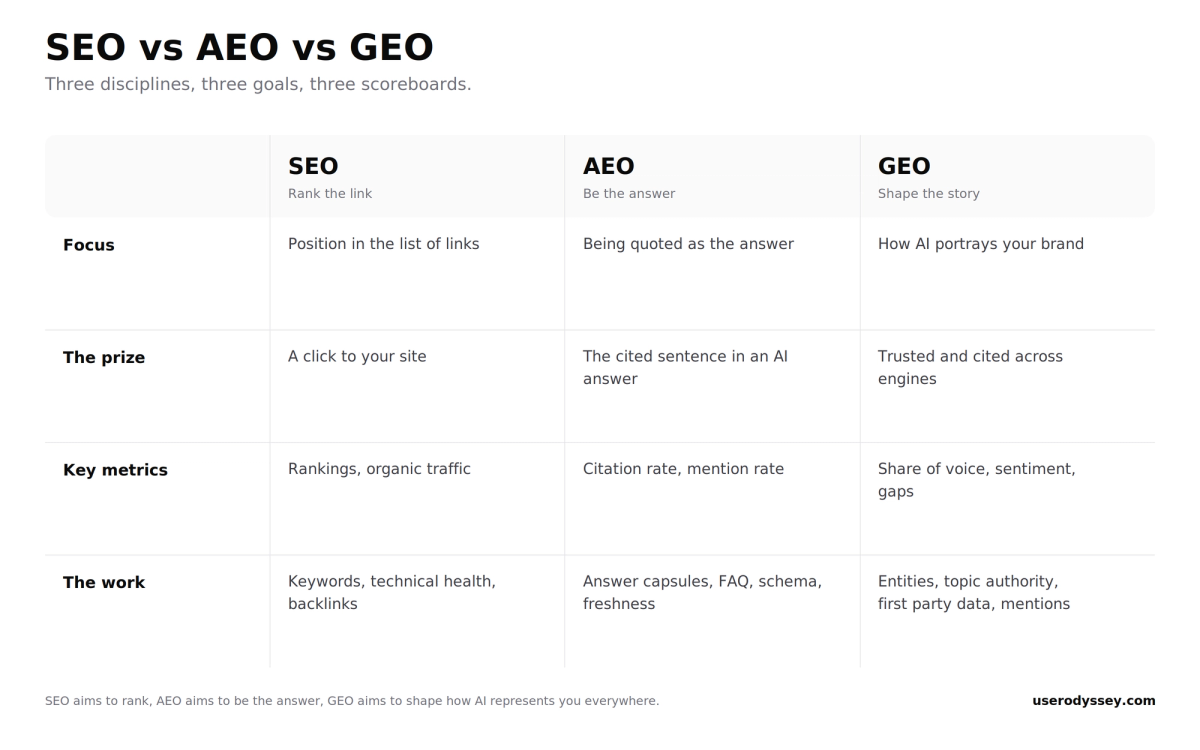
SEO: ranking the link
Search engine optimization optimizes for position in a results page. Success is keyword rankings, organic traffic, and clicks. It is still the foundation, but the ground is shifting fast. As recently as mid 2025, roughly three quarters of Google AI Overview citations came from pages that also ranked in the top 10 for the same query. By early 2026, separate studies from Ahrefs and BrightEdge put that overlap somewhere between 17% and 38%, because Google's query fan out now assembles answers from a much wider pool of sources. The takeaway is simple: ranking still helps, but it is no longer the finish line. It is necessary, not sufficient.
AEO: being the answer
Answer Engine Optimization is the practice of structuring content so AI engines such as ChatGPT, Perplexity, Google AI Overviews, Gemini, and Copilot can extract, trust, and cite it directly in a generated answer. The real estate is no longer a blue link. It is the sentence the AI delivers and the source it credits.
AEO success looks different: citation frequency, brand mention rate, and share of voice across AI platforms. A page can rank first on Google and still be completely absent from the AI answer sitting above it, because the model did not find it easy to quote or trust. AEO closes that gap with clear answer capsules, FAQ and question style headings, schema markup, original data, and freshness.
GEO: shaping the whole representation
Generative Engine Optimization is the widest lens. It is not just "did I get cited," it is how is my brand portrayed when AI talks about my category. GEO covers your mentions, your sentiment, the sources shaping those mentions, and the gaps where competitors own topics you do not. It leans on consistent entities, topic authority, first party data, and being referenced steadily across the trusted sources models learn from. A monitoring number tells you your AI share of voice is 8%. A GEO view tells you which topics competitors own that you do not, and why.
In practice the terms blur. Many people use AEO and GEO interchangeably, and that is fine. What matters is recognizing they describe a discipline that is distinct from classic SEO.
A simple way to hold all three in your head: SEO aims to rank, AEO aims to be the answer, and GEO aims to shape how AI represents you everywhere.
So where do you put your effort?
Think of it as a stack, not a choice.
- Keep the SEO foundation. Ranking is no longer sufficient, but it still helps, and more than half of searches still show no AI Overview at all, so organic results remain the entire experience for a large share of queries.
- Layer AEO on top. Restructure your best pages around real buyer questions, lead with the answer, prove each claim with evidence, and keep them fresh.
- Manage GEO continuously. Track mentions, sentiment, and source gaps across engines, because AI answers are inconsistent enough that a single snapshot tells you nothing.
What comes next: from cited to chosen
The frontier is already moving past citations. AI agents are starting to act on behalf of buyers, comparing options, shortlisting vendors, and even completing tasks before a human visits a single site. When that becomes normal, the question shifts from "did AI mention me" to "did AI choose me." The brands that win will be the ones with accurate, structured, consistent information that an agent can read, trust, and act on. The AEO and GEO work you do now is the foundation for that next shift.
The measurement problem
Here is the catch that trips everyone up: your traditional SEO dashboard offers zero insight into any of this. Rankings and traffic do not tell you whether ChatGPT names you when a buyer asks for a recommendation, how often you are cited versus a competitor, or whether your brand is described positively. Those are new metrics that need new measurement.
That is the layer UserOdyssey covers, running your category prompts across seven AI engines and tracking visibility, share of voice, position, mentions, and sentiment, so the AEO and GEO work you do has an actual scoreboard.
Frequently asked questions
What is the difference between SEO, AEO, and GEO? SEO ranks your page in a list of links. AEO structures your content to be quoted directly as the answer in AI results. GEO shapes how generative engines represent and cite your brand across every AI surface.
Is AEO the same as GEO? Not quite, though people often use the terms interchangeably. AEO focuses on being the cited answer on a given page. GEO is the wider practice of managing your mentions, sentiment, and citations across all generative engines.
Does SEO still matter in 2026? Yes. Ranking no longer guarantees an AI citation, but it still helps, and most searches still return no AI Overview, so organic results remain the whole experience for many queries.
How do you measure AEO and GEO? With metrics that traditional SEO tools do not track: citation frequency, brand mention rate, share of voice across AI engines, and sentiment, measured continuously across many prompts because AI answers vary so much.
Curious where you stand? Run a free audit and see how AI represents your brand right now.