Short answer: getting cited in ChatGPT comes down to three things. Be discussed, accurately and consistently, across the sources ChatGPT already trusts. Publish content structured so a model can lift a clean answer and attribute it to you. Then measure your mentions across many prompt variations over time. Your own website matters, but your footprint on other sites matters more.
That last point surprises most marketers, so we will start there.
Why this matters now
Search is splitting in two. AI search visits grew roughly 43% year over year heading into 2026, while traditional Google search stayed essentially flat, and Gartner projects traditional search volume falling about 25% as answer engines take share. The visitors matter more, too. Seer Interactive found that AI search visitors convert at roughly 4.4 times the rate of the average organic visitor, because they arrive having already read a synthesized comparison and are further along in their decision.
[GRAPH: "Why Getting Cited in AI Search Matters" 3 stat graphic here]
Translation: when a buyer asks ChatGPT "what is the best tool in my category?" the answer either includes you or it does not. If it does not, you lose the deal before they ever reach your site.
How ChatGPT decides who to mention
ChatGPT pulls from two places: its training data, meaning what the web said about you over time, and real time retrieval, meaning what it can fetch and read right now. Winning both requires the same thing, a credible and consistent presence across the sources the model trusts.
The single most important finding of the last year came from Ahrefs and its study of 75,000 brands. The strongest predictors of showing up in AI answers were not backlinks, domain rating, or content volume. They were mentions on other sites. YouTube mentions now top the list, with branded mentions across the open web close behind. Both correlate roughly 3 times more strongly with AI visibility than backlinks do. ChatGPT cites you because other people already discuss you.
The one tactic that beats everything else: the answer capsule
If you do only one thing on your own pages, do this. An audit of nearly two million sessions across 15 domains found that the single strongest predictor of a ChatGPT citation was the presence of an answer capsule. Roughly 72% of cited posts had one.
An answer capsule is a short, standalone answer of about 20 to 25 words, placed immediately under a heading that is written as a question. It hands the model a clean, quotable block it can lift and attribute without guessing.
Two rules make capsules work.
First, keep them free of links. In that same audit, about 91% of the capsules in cited posts contained no links at all. From a model's point of view, a link inside the answer signals that the real answer lives somewhere else, so it reads as a hesitation. Put your links in the supporting paragraphs below, never inside the capsule itself.
Second, back the capsule with original data. Pages that paired a capsule with original or owned data were the strongest performers in the audit. Original data is anything that starts on your page, such as a survey result, a benchmark, or a metric only you have. Owned data is your branded read on known information, framed clearly as yours, for example "Our recommendation: prioritize capsule clarity over keyword density." Both give the model a concrete reason to attribute the quote to you by name.
The rest of the playbook
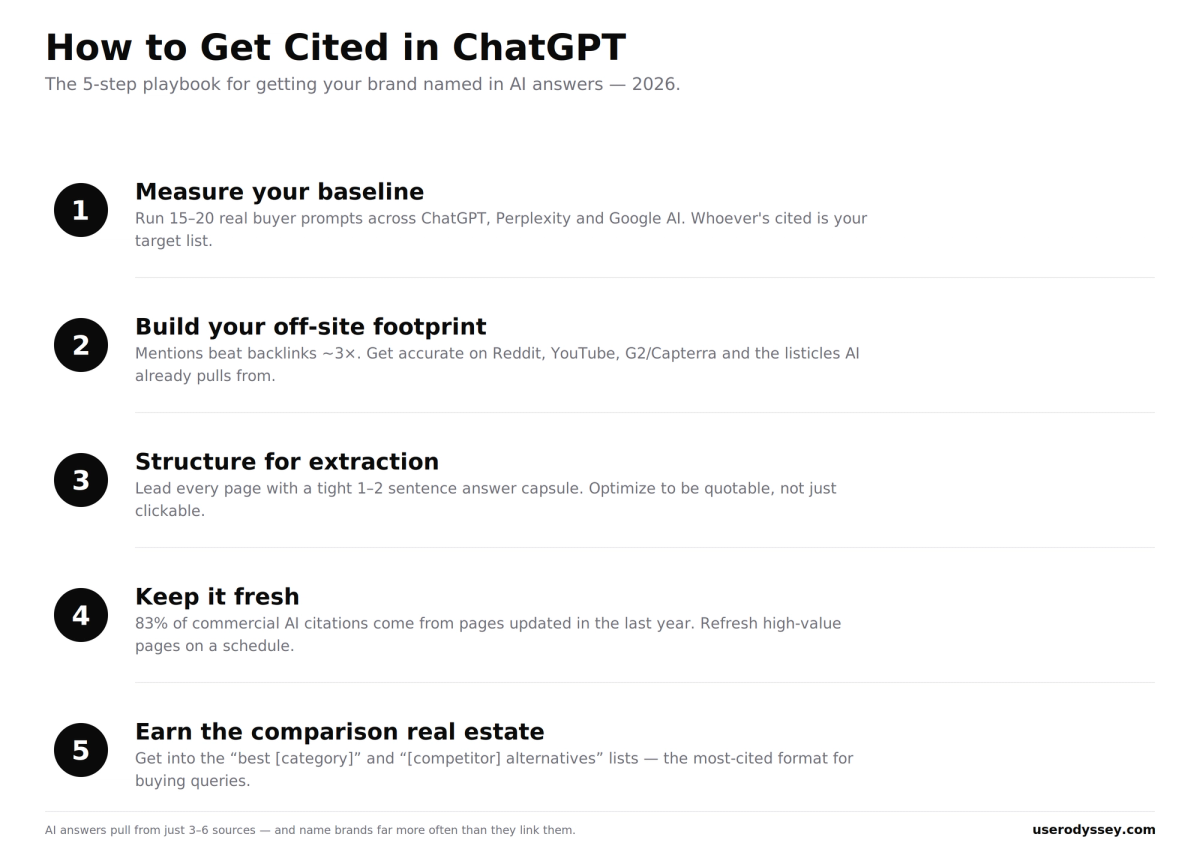
- Measure your baseline. Run 15 to 20 real buyer prompts across ChatGPT, Perplexity, and Google AI Mode. For each one, note whether you are mentioned, which competitors are, and which sources get cited. That citation list is the model showing you its own reference list. It tells you exactly where you need to appear.
- Build your presence on other sites. Reddit and Wikipedia account for a large share of cited sources, and models lean heavily on YouTube, G2, Capterra, and roundup comparison articles. Get accurate, current listings on the review sites and directories in your category, and answer real questions in the threads where your buyers already are, using the exact phrasing you want tied to your brand.
- Keep it fresh. AirOps found that about 83% of AI citations on commercial queries came from pages updated within the last 12 months. Refresh your most important pages on a schedule. Stale pages quietly fall out of the answer pool.
- Make your pages easy to parse. Use headings written as questions, clear FAQ sections, and FAQ and Article schema, so a model can read your structure without guessing.
- Earn the comparison real estate. "Best in category" and "alternative to a competitor" articles are among the most cited formats for buying queries. Getting into the lists AI already pulls from is often higher leverage than another post on your own blog.
The mistake almost everyone makes
Testing once. AI recommendations are wildly inconsistent. Ask ChatGPT the same question repeatedly and it rarely surfaces the same set of brands twice. A single good result means nothing. You have to track citation and mention rates across many prompt variations, continuously, to know whether your work is actually moving your visibility.
Frequently asked questions
How do you get cited by ChatGPT? Get mentioned consistently across the sources ChatGPT trusts, such as Reddit, YouTube, and review sites, then publish short, link free answer capsules backed by your own original data.
What is an answer capsule? It is a short, standalone answer of about 20 to 25 words placed directly under a question heading, with no links inside, so a model can quote it cleanly and attribute it to you.
Do backlinks help your brand show up in AI answers? Far less than mentions do. In Ahrefs' study of 75,000 brands, mentions on other sites predicted AI visibility roughly 3 times more strongly than backlinks did.
How long does it take to get cited by ChatGPT? Most brands start seeing citations within three to six months of consistent work, though existing authority and an active presence on other sites can speed that up.
Where to start
You cannot improve what you do not measure. UserOdyssey runs your category prompts across seven AI engines, ChatGPT, Gemini, Perplexity, Grok, Copilot, Google AI Overview, and AI Mode, and tracks your visibility, share of voice, citations, and sentiment over time, so you can see exactly where you are the answer and where a competitor is taking your spot.
Start with a free audit and find out what AI is saying about your brand today.