Short answer: the domains AI engines cite most are Reddit, YouTube, Wikipedia, LinkedIn, and the major review sites (G2, Yelp, Trustpilot). But the exact ranking shifts depending on which engine you measure, and the domains that actually decide whether your brand gets recommended are specific to your industry — not any global top 10.
Here's what the data shows, and what to do with it.
The aggregate picture
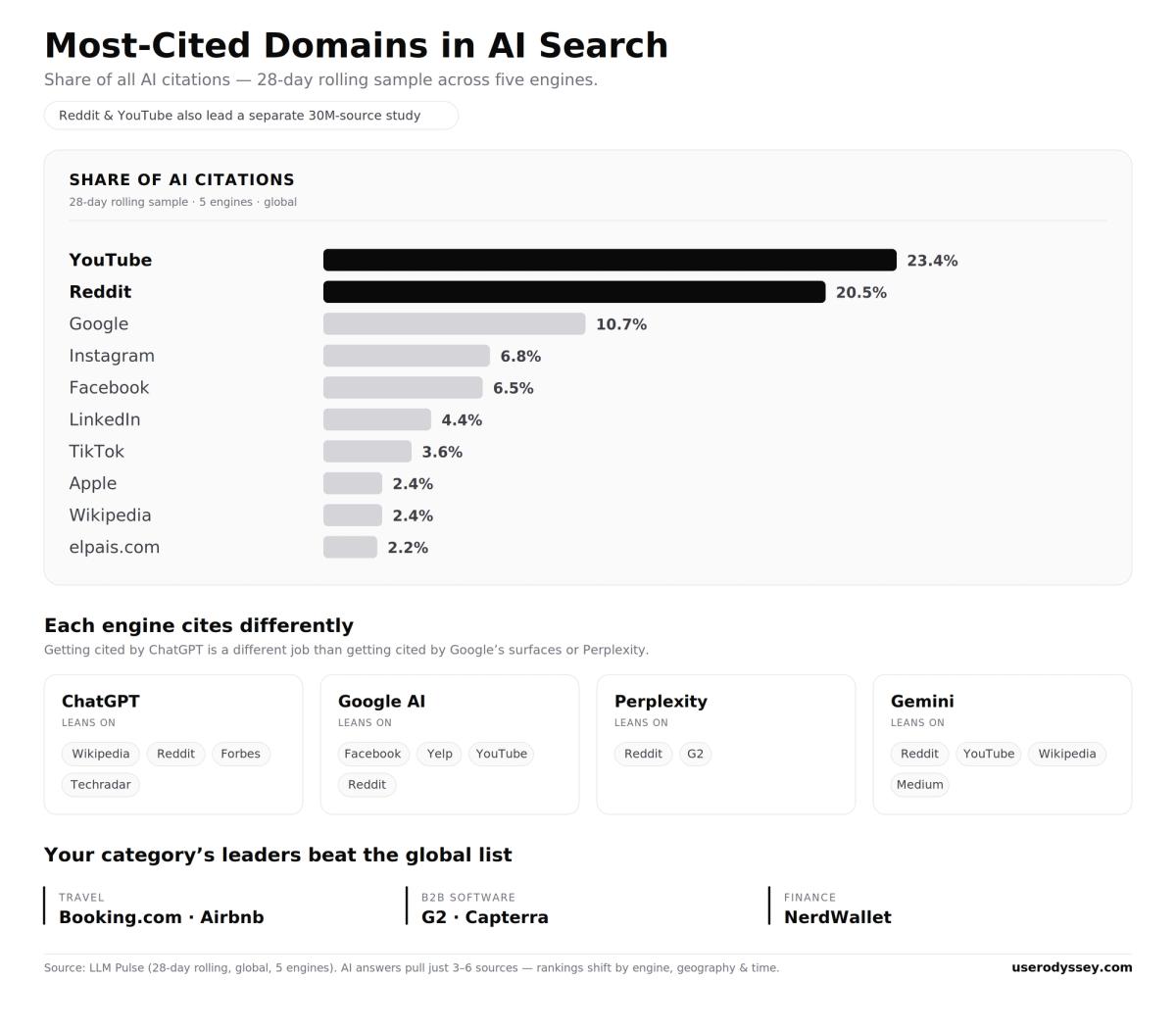
Across a rolling 28-day sample of AI citations spanning five engines (ChatGPT, Gemini, Perplexity, Google AI Mode, and AI Overviews), a handful of domains take the lion's share:
[GRAPH: Most-Cited Domains in AI Search — insert the cover graphic here]
Reddit and YouTube are the two most-cited domains on the internet, full stop. They top this sample, and they also lead a separate analysis of 30 million cited sources — so the agreement at the top is real and stable. If you have no presence on either, that's your first gap.
Below the top two, the list is far less stable: social platforms, Google's own properties, Wikipedia, and even regional news sites trade places depending on the query mix, the geography, and the time window. The lesson isn't to chase any single ranking — it's that a global top-domains list is unstable by nature, so treating it as your content strategy is a mistake.
The rankings change by engine, too
Each engine cites differently:
- ChatGPT leans on authoritative editorial and reference: Wikipedia, Reddit, Forbes, Techradar.
- Google AI Mode & AI Overviews lean social and local: Facebook and Yelp alongside YouTube and Reddit.
- Perplexity is Reddit-heavy and, notably, pulls G2 — which matters a lot if you're B2B.
- Gemini mixes Reddit and YouTube with Wikipedia and Medium.
So "get cited by AI" isn't one job. Getting cited by ChatGPT (Wikipedia, editorial) is a different play than getting cited by Google's surfaces (social, reviews) or Perplexity (Reddit, G2).
The catch: a global top 10 is a starting point, not a strategy
Here's the trap. AI answers are narrow — where a Google results page surfaces ~10 domains, an AI answer typically pulls from just 3 to 6 sources. That concentration means being "somewhere on the web" isn't enough; you need to be on the handful of domains AI reaches for in your specific category.
And those category domains often beat the global giants. In travel, Booking.com and Airbnb routinely outrank Reddit as cited sources. In B2B software, G2 and Capterra carry outsized weight. In finance, it's NerdWallet and a cluster of editorial finance sites. None of that shows up on a generic top-10 list — but it's exactly what determines whether AI names you or a competitor.
What to actually do with this
- Cover the universals. Make sure your brand is accurately represented on Reddit, YouTube, Wikipedia (if you qualify), and LinkedIn. These appear across every engine.
- Find your category's real citation leaders. Run your actual buyer prompts and look at which domains the AI cites in your answers — not the global list.
- Audit the gaps. Where are competitors cited and you're not? Those specific domains are your outreach and content roadmap.
- Measure per engine, over time. The rankings drift, and each engine differs. A one-time snapshot tells you almost nothing; a tracked trend tells you whether your work is landing.
See your own list
The global top 10 is interesting trivia. The list that grows your pipeline is the one specific to your prompts, your industry, and each engine. UserOdyssey runs your category's prompts across seven AI engines — ChatGPT, Gemini, Perplexity, Grok, Copilot, Google AI Overview, and AI Mode — and shows you exactly which domains AI cites when it answers questions in your space, ranked by influence, with your competitors side by side.
Run a free audit and get your own most-cited-domains list — the one that actually matters for your brand.